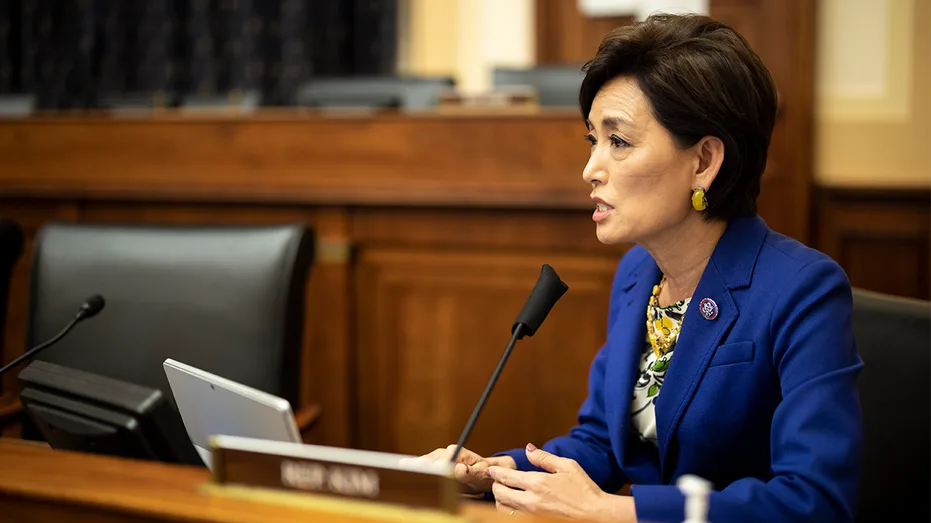
A California Republican is championing a new initiative aimed at closing what she describes as another avenue for congressional self-enrichment, building on recent efforts to restrict lawmakers' stock trading. This comes as public frustration continues to mount over the rapid increase in wealth experienced by many elected officials during their time in public service.
Representative Young Kim's Stop Congressional Self-Enrichment Resolution follows a successful Republican-led push in July that implemented new restrictions on stock purchases and mandated several days' notice before stock sales. Her proposed measure seeks to address all material financial interests, whether direct or indirect, that could benefit not only the lawmaker but also their family members.
"And with the federal funds that the member brings and build the park nearby or community center nearby, it could increase the property value and therefore indirectly benefiting the member and their family members. Maybe asking to build a road up to rural land the member owns."
Current House regulations stipulate that members requesting earmarks must certify that neither they nor their spouses hold a financial interest in the recipient entity. Kim's resolution would expand this requirement to include immediate family members and indirect financial interests, such as the appreciation of nearby property values.
"The days of members thinking that ‘I can use the community project funding request or bringing the earmarks for my district and get filthy rich off of it’ -- those days are numbered."
Kim emphasized the timeliness of her proposal, noting widespread public sentiment. "This is a good time because we see Americans are sick and tired of watching politicians getting filthy rich while average Americans are worrying about making ends meet and stretch every dollar that they earn," she stated.
Expanding Ethical Oversight
Representative Kim clarified that her efforts are not intended to target any specific individuals. She also stressed that her resolution does not aim to discourage lawmakers from advocating for their districts or securing appropriate taxpayer dollars for local projects.
"And, this is not in any way discouraging members to fight for their districts and bring in the appropriate taxpayer dollars for projects near their districts," she said.
She highlighted her own work in securing funding for Orange County to aid in wildfire prevention and recovery, among other constituent interests. "That is so important," she remarked. "That's what we are sent to do, fight for our district, but not at the expense of, you know enriching I mean, not at the expense of hurting our very constituents that we are trying to support while we are lining our pockets, because there are too many career politicians in Washington looking out for no one but themselves."
Historical Context of Earmarks
Lawmakers have faced criticism for their use of earmarks over many decades. Kim referenced the "Bridge to Nowhere" project in Alaska's Inside Passage in the early 2000s as a significant example that underscored concerns about earmark abuse. She noted that a subsequent decade-long moratorium on earmarks helped curb such practices.
While acknowledging that safeguards implemented after the moratorium have been beneficial, Kim argued that members can still secure indirect benefits for themselves. Her resolution seeks to close these remaining gaps.
Past Cases of Scrutiny
One prominent instance involved then-House Speaker Dennis Hastert, an Illinois Republican, who faced scrutiny in 2006 regarding a $207 million earmark for a parkway near property he owned. At the time, an attorney for Hastert dismissed the accusations from a good-government group as "libelous," asserting that criticizing Hastert for the project was comparable to "complaining about a purchase in Alexandria based on renovations at the Capitol."
More recently, in 2023, the Boston Globe reported on earmarks secured by Massachusetts Democrat Representative Stephen Lynch that reportedly benefited a health center in Boston where his wife was employed.
Similarly, Virginia Democrat Senator Tim Kaine previously obtained earmarks totaling $3.5 million for George Mason University, where his wife had served as interim president and later as a professor. A spokesperson for Kaine addressed these concerns, telling The Messenger news outlet that the earmarks "are in no way influenced by Secretary Holton," referring to Anne Holton, former Virginia Education Secretary. The spokesperson clarified that "Secretary Holton has no involvement in the CDS process, and no involvement in the George Mason CDS requests," using the acronym for 'Congressionally Directed Spending,' the Senate's term for earmarks. "Senator Kaine and Secretary Holton have not discussed the requests," the spokesperson added.
As the Senate prepares to consider prohibitions on stock trading, Representative Kim's bill is presented as a crucial measure to address remaining loopholes in a practice that garners rare, emphatic bipartisan support for reform.