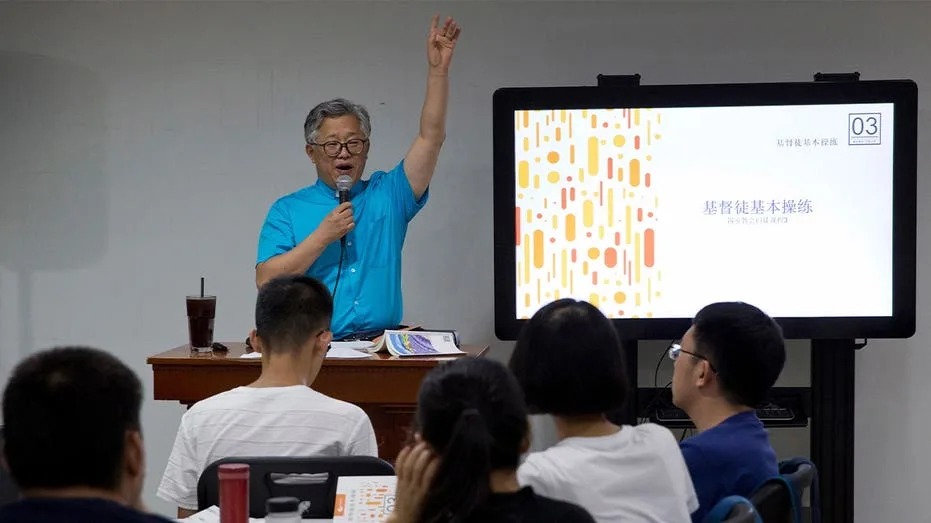
"A China that lacks religious liberty is fundamentally unacceptable," stated Pastor Ezra Jin to a small assembly on Capitol Hill, shortly following his release from a Chinese correctional facility. His freedom came weeks after then-President Donald Trump reportedly discussed Jin's situation with Chinese President Xi Jinping during their summit in May. The question remains: what led to his imprisonment? Pastor Jin had served as the spiritual leader of Beijing's Zion Church, an independent Christian house church operating without the oversight of the Chinese Communist Party (CCP).
Widespread Suppression of Faith Within China
In China, all religious organizations are mandated to operate under the direct authority of the CCP; failure to comply often results in harassment, detention, facility closures, or more severe consequences. Documented evidence points to practices such as forced organ harvesting targeting Falun Gong practitioners, a Chinese spiritual discipline specifically singled out by the CCP for brutal suppression.
Currently, ten Chinese Catholic bishops are reportedly held in various forms of detention for resisting adherence to the CCP's directives. Cardinal Joseph Zen, a 94-year-old revered figure in Hong Kong's religious community for decades, was recently found guilty of offenses related to the registration of a charity fund. His opposition to a confidential agreement between the Chinese government and the Vatican regarding the selection of Catholic bishops in China is well known.
Additionally, Gedhun Choekyi Nyima, the Panchen Lama and second-highest spiritual authority in Tibetan Buddhism, was reportedly abducted by Chinese authorities 31 years ago, and his whereabouts remain undisclosed.
While specific situations vary, a consistent pattern emerges: faith leaders and communities operating independently of Beijing's control are subjected to intimidation, imprisonment, enforced disappearance, or worse.
This state-controlled religious system directly contradicts the United Nations' Universal Declaration of Human Rights and the widely held belief that every individual possesses the inherent right to determine their own spiritual path. A system that dictates the most fundamental personal beliefs is incompatible with economic support from nations valuing individual freedoms.
Transnational Repression and International Implications
The reach of Beijing's repressive policies extends beyond its national boundaries. The CCP is actively engaged in what is termed "transnational repression," a campaign involving harassment, misinformation, and legal maneuvers targeting religious and political dissidents, including those residing in the United States. Falun Gong adherents in the U.S. have reported nearly 300 instances of bomb and death threats. This external pressure occurs concurrently with the ongoing severe persecution within China, where over 5,000 confirmed deaths of Falun Gong practitioners have been documented since the government's crackdown commenced in 1999.
Recently, artificial intelligence company Anthropic disclosed that it had thwarted intelligence operations originating from China. These operations allegedly utilized its Claude AI platform to compile surveillance dossiers on various overseas dissident groups, including Tibetan Buddhist, Falun Gong, Christian, and Uyghur communities, with activities extending to the U.S. This demonstrates a consistent pattern by Beijing of leveraging American institutions and technological advancements to harass and oppress dissidents who had sought refuge and safety in the United States.
The Ideological Roots of Control and the Call to Action
With Chinese President Xi Jinping slated to visit Washington on September 24, it is imperative that the US leader prioritizes a discussion on this pervasive system of state coercion and control. Nations that deny their citizens the fundamental right to worship freely cannot be considered dependable trading partners, nor should they be economically bolstered by American investments. While such regimes may offer inexpensive goods, the intrinsic value of human freedom and spiritual conscience is immeasurable and not subject to economic exchange.
At its core, communism formally rejects the concept of a divine being and positions the government as the ultimate authority. Consequently, all aspects of life are subject to state control unless specific freedoms are explicitly granted. Under this doctrine, individual rights are derived from the state, rather than from any higher power or inherent human dignity.
Totalitarian and authoritarian systems have long understood the necessity of controlling religious populations. Individuals with faith often pledge allegiance to a higher authority, an allegiance that can embolden them to challenge and resist governmental overreach when it acts unjustly, even when facing the loss of their possessions, liberty, or lives.
These are precisely the individuals deserving of advocacy. Historical examples include the Jewish refuseniks and evangelical communities who defied the Soviet regime, and the Christians in Myanmar who currently resist the ruling military junta.
However, the pursuit of freedom carries a price. This inherent cost is what makes freedom so invaluable. For Americans, this cost is not the forfeiture of our own liberties, as it is for Chinese Christians, Buddhists, Falun Gong practitioners, or Uyghur Muslims. Instead, it is our collective resolve to challenge China's oppressive actions.
A Stance for Freedom and Faith
The US leader has been recognized as the first president since John F. Kennedy to directly challenge China, a stance that merits commendation and encouragement for further action. Measures such as increased tariffs have been imposed on a communist government perceived as seeking global hegemony. Furthermore, China's international partners in regions like Iran, Venezuela, and Cuba have faced increased scrutiny and weakening.
It is crucial to continue applying this diplomatic and economic leverage to protect those whose only transgression is their refusal to subjugate their faith to the dictates of the Chinese Communist Party. Now is a pivotal moment to directly confront the CCP's pervasive system of religious oppression—mirroring the historical confrontation with the Soviet system by President Reagan—and to unequivocally state that the people of China should not be forced to choose between their religious beliefs and their fundamental freedoms.
The American public will not tolerate Beijing's interference when it extends across international borders, seeking to suppress, silence, or penalize individuals for upholding both their faith and their liberty.
When President Xi arrives in Washington, the US President should convey this message with absolute clarity.