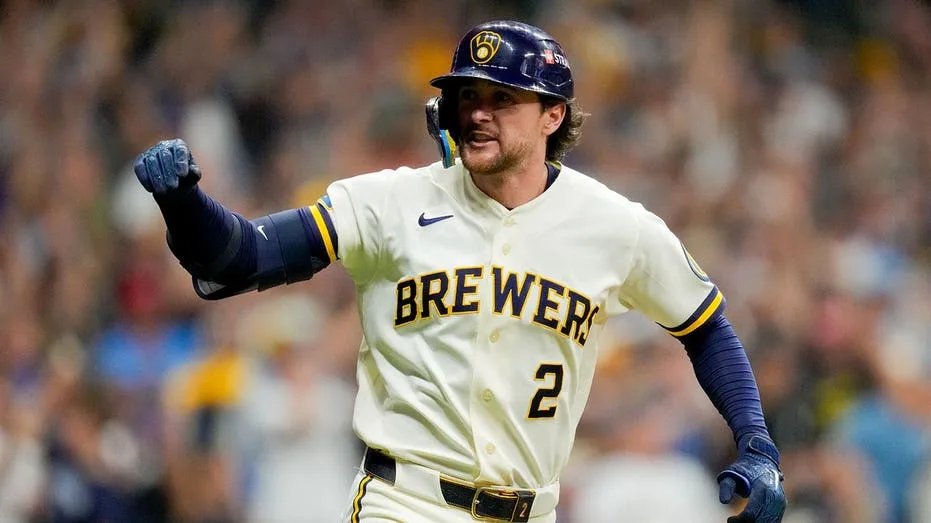
Game 2 of the National League Championship Series on Monday afternoon presented a critical juncture for the Los Angeles Dodgers. Despite their reputation as a formidable superteam, it was the Milwaukee Brewers, who concluded the regular season with the league's top record, that had delivered a nearly flawless performance in Game 1.
In the opening game, even when Jacob Misiorowski wasn't at his most dominant, Milwaukee's defense consistently thwarted Los Angeles's scoring opportunities. For instance, in the second inning, with the bases loaded and postseason standout Kike Hernandez at the plate, the Brewers' defense executed a perfectly positioned double play to end the threat. Following Milwaukee's two-run rally against Tarik Skubal, their bullpen maintained its impressive streak, pitching 4.2 scoreless innings to clinch the victory.
Heading into Game 2, the Dodgers held optimism with Yoshinobu Yamamoto, a celebrated postseason pitcher from 2025, scheduled to start against Logan Henderson. However, despite the significant anticipation surrounding Los Angeles's stellar pitching rotation, Milwaukee's knack for timely hits on balls in play (BABIP) once again proved decisive. The Brewers secured a crucial 7-4 win, extending their series advantage to 2-0 and placing the Dodgers' aspirations for a third consecutive championship in jeopardy.
Early Exchanges and Milwaukee's Timely Responses
Los Angeles initially seized an early lead due to some uncharacteristic errors by the Brewers. Mookie Betts drew a walk, Freddie Freeman advanced him to second, and he then moved to third on a wild pitch from starter Logan Henderson. Teoscar Hernandez then brought Betts home with a sacrifice fly, giving the Dodgers a 1-0 lead without recording a single hit. Milwaukee, however, promptly leveled the score in the bottom of the first inning.
The Dodgers missed an opportunity to challenge an evident missed strike three call against Brice Turang, who subsequently hit a double and scored on what has become a signature Brewers bloop single. William Contreras, with a one-handed swing, inexplicably made contact with Yamamoto's pitch, sending it into left field. This type of hit would recur throughout the game.
The third inning unfolded similarly. Los Angeles initiated a quick rally with consecutive singles from Tommy Edman and Mookie Betts. Sal Frelick made an excellent running catch in the right-center field gap, robbing Freddie Freeman of a potential double. An error on a pickoff attempt at first base then allowed Edman to score. Yet, the Brewers, seemingly aware of the Dodgers' struggles with runners in scoring position, contained the rally effortlessly. Easy outs from Teoscar Hernandez and Shohei Ohtani extinguished the threat, and Milwaukee responded immediately in the bottom of the inning.
David Hamilton notched another bloop single, stole second, and once more, Brice Turang reached base on an uncalled strike three that went unchallenged by catcher Will Smith. Jake Bauers, who had struggled at the plate before joining Milwaukee, drew a walk after an extended at-bat against Yamamoto, setting the stage for Christian Yelich to drive in a run with a single to center field.
Despite his playoff heroics in 2025, Yamamoto's outing lasted only 2.2 innings, during which he surrendered four hits and three runs. A combination of missed challenges, bloop singles, and well-timed line drives from hitters with modest averages characterized Milwaukee's ideal offensive display.
Bullpen Brilliance and Continued Small Ball Success
Now trailing 3-2, the Dodgers mounted a rally in the fifth. Kyle Tucker led off with a double, and a throwing error by Henderson on a Tommy Edman bunt allowed Tucker to score and Edman to reach second. A subsequent grounder and sacrifice fly propelled Los Angeles to a 4-3 lead, once again without recording a hit with runners in scoring position.
Predictably, William Contreras immediately equalized the score in the bottom of the inning with a powerful home run to left-center field.
The Brewers' bullpen, which appeared unhittable, delivered another scoreless inning. Then, in the bottom of the sixth, Milwaukee's strategic offense once again came to life. Hamilton was hit by a pitch, advanced to second on a poor pickoff attempt, moved to third on a Jackson Chourio groundout, and scored on yet another soft-contact blooper from Contreras.
Milwaukee's relief pitchers continued their remarkable performance, extending their collective scoreless streak to nearly 29 innings with only one run allowed. Monday's game marked the first instance in playoff history where a team's bullpen pitched over five innings in a postseason game without yielding a baserunner. This unit, comprised of JoJo Romero, Abner Uribe, Trevor Megill, Aaron Ashby, and DL Hall, has proven to be an incredibly effective, yet cost-efficient, pitching staff.
The trend of advantageous hits on balls in play persisted into the eighth inning, as David Hamilton drove a 73 mph single to right field, stole second, and scored on another well-placed 71 mph single from Brice Turang. This hit improved the Brewers' performance with runners in scoring position to 5-for-12. Jake Bauers further extended the lead with another 73 mph bloop single, making Milwaukee 6-for-13 with runners in scoring position.
The Unpredictable Nature of Playoff Baseball
Somehow, Milwaukee has mastered the art of converting softly hit balls into singles. While some might consider this a skill, decades of baseball data suggest otherwise. Players and teams with low exit velocities typically do not overperform in batting average on balls in play; in fact, the opposite is often true.
This season's league leaders in hard-hit percentage included:
- [Player 1 - Wood]
- [Player 2 - De La Cruz]
- [Player 3 - Caglianone]
- [Player 4]
- [Player 5]
All five players maintained BABIPs at or above the league average, with Wood and De La Cruz recording .344 and .359, respectively. Jac Caglianone, eighth in hard-hit percentage, ranked second in baseball for BABIP. Hitting the ball hard is generally recognized as a skill, whereas soft contact is not. Yet, the Brewers notably have three hitters among the top seven in BABIP.
Whether Milwaukee's success this season has been influenced by luck is a valid question, but in the context of a playoff series, which represents a small sample size, the concept of regression to the mean may not apply over five to seven games. Contreras, for example, could theoretically hit seventeen consecutive bloopers off the end of his bat, as such anomalies are simply part of baseball. This inherent unpredictability is why predictions of a guaranteed World Series victory for the Dodgers, based solely on their talent, were always viewed skeptically.
In this particular game, Milwaukee recorded more soft-contact hits with runners in scoring position than the Dodgers have managed throughout the entire postseason. The Brewers are now returning to Los Angeles with a commanding 2-0 series lead and a significantly increased probability of advancing to the World Series. The margins between teams in baseball are so narrow that a single fortunate bounce or a team's uncanny ability to perfectly place 71 mph bloopers, despite the absence of a discernible skill to do so, can fundamentally alter a playoff series. David Hamilton, who is objectively not considered a top-tier baseball player, reached base four times and scored two runs, while Shohei Ohtani, widely regarded as one of the sport's greatest players, had minimal impact. This outcome is neither unusual nor unexpected; it is an intrinsic element of the game, underscoring why no single team can guarantee itself ultimate success.